From the Field
Farmers State Bank Research Plot Update | July 2026
By Jagr McGath
June rainfall has fueled impressive crop growth across West Central Illinois, but it has also introduced new management decisions for producers. As corn approaches tasseling and soybeans continue developing, timely fungicide applications and changing field conditions are becoming a major focus throughout the region.
At the Farmers State Bank Research Plots, this week marked an important milestone as we completed the first fungicide application on the portion of our corn plot designated for our two-pass fungicide trial.
Research Plot Update
Our first fungicide application included 8 oz. of Delaro® Complete (Bayer), along with a foliar feed and Agri-Yield All-E-Vyte™ supplied by Logan Agri-Service.
Rather than using a traditional ground sprayer, this application was made using agricultural drone technology operated by Blake McGrew of Drone Deploy Aerotech. Drone applications provide excellent coverage while eliminating wheel tracks and minimizing crop damage caused by equipment traveling through the field.
In the next few weeks, the remaining research plots will receive a single fungicide application by airplane. The two-pass treatment area will receive a second aerial application, allowing us to compare the effectiveness of one versus two fungicide applications under this year's growing conditions.
Crop Progress
The old saying was that corn should be "knee-high by the Fourth of July." Today, many producers hope to see that milestone by the Fourth of June.
Our research plots have certainly kept pace.
Corn across the plots is currently ranging from V7 to V10, with most plants standing approximately 40 inches tall. At this stage, the crop is rapidly building biomass ahead of tasseling and is showing a uniform stand with excellent color—both indicators of healthy plant development and favorable nutrient availability.
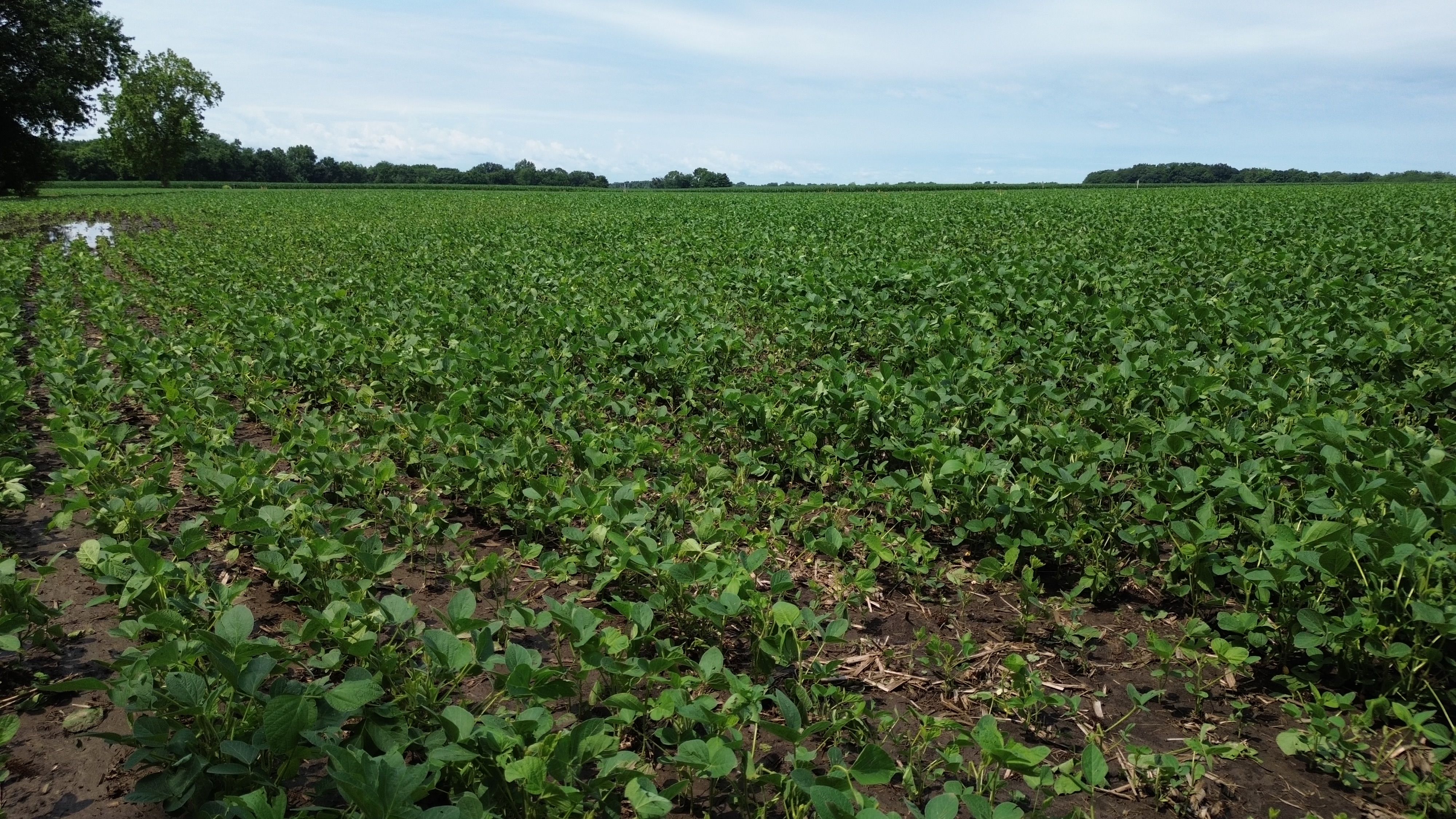
Soybeans continue adding canopy and branching as they move through vegetative growth stages, benefiting from adequate soil moisture and warm temperatures.
Rainfall: A Blessing and a Challenge
June rainfall has provided much-needed moisture across Pike and Greene Counties, supporting strong crop growth throughout the area. According to National Weather Service observations, Pike County received approximately 4 to 7 inches of rainfall during June, while Greene County received 5 to 8 inches.
While this moisture has encouraged rapid crop development, excessive rainfall has also created new challenges.
Periods of heavy rainfall have left some fields saturated, limiting soil drainage and increasing the potential for nutrient movement, particularly nitrogen. Extended periods of standing water can stress root systems, reduce nutrient uptake, and create uneven crop development across fields.
These conditions reinforce the importance of continually monitoring crop color, stand consistency, and overall field health as the season progresses.
Looking Ahead
The next several weeks represent one of the most important periods of the growing season.
We'll continue sharing observations from the field throughout the season as this year's story unfolds, providing local producers with practical insights from our 2026 Farmers State Bank Research Plots.